Of the many encompassing channels of video games, one that is often talked about is whether or not the narrative was “good”. Never if it was compelling, nor if it made sense; was it good or bad. This isn’t to say this isn’t a fair point to make, as people have been arguing for millennia what constitutes good media, but it is a bit reductive. What is more fascinating, in my view, is how games incorporate this story into the rest of its totality. From the mechanics to the environment, I want to see how the game as a whole tells a story. Much like how YouTuber Shammy feels the need to coin a term like ‘ludotography’ for the process of games incorporating ‘gameplay loops into their story’, I feel the need to explain what I am asking of the industry.
This demand, I must admit, is a niche one, especially in an industry where “kill all demons in hell” is a fantastic premise for what the game is pursuing. But when it comes to games trying to actually tell a compelling story, there is a lacking agreeance from the audience as to what this means.
This is not entirely the audience’s fault, as video games have always had an odd tenuous relationship to narrative, and only recently has that link become more popular to explore as games find the limits of how far technology can really sell a product. This has not always been the case, and is certainly not a law, as many games have taken their place in “Hall of Fame” for their revolutionary technology and massive advancements forward, such as Mario 64‘s 3D revolution. However, as the revolution from developed 2D games to 3D was huge, there hasn’t been a revolution on the same level since, in my opinion. Amongst these various other technological revolutions we have had countless other games that were memorable without considering their technology. To simplify, there are two ways games have become hallmarks of the industry; the advancements they achieve, and the lasting stories they tell. Much like how 3D films were a fad of cinema, the current trend around ray-tracing will be little more than a blip in the history of games, compared to the lasting tales of games like The Last of Us.
The Ludo and the Narrative
The problem the industry is facing is something unique to interactive narratives, which is the dual-channel of information from the gameplay (ludo) and the narrative that is being experienced. Games are much more than film, literature, and music combined. They can (and often are) all those media forms in one, with the addition of a fourth mode of interactivity. Video games are so diverse, there has been multiple attempts to coin terms that encompass this range, such as ‘crossmedia packages’ (Aarseth), or future narratives (Domsch). The truth is games are so many forms in one that it’s easier to define them by what makes them unique, rather than what they share with other media. Obviously the preference is to refer to them by all these constituent parts, but I said easiest didn’t I? The interesting dynamic is how video games find themselves coming to this dual-channel of ludo-narratives as a frictional contradiction, rather than a consonant opportunity.
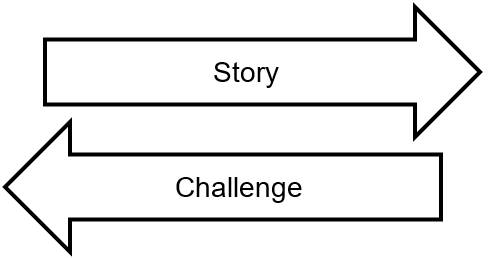
Jonathan Blow talked about this friction in his 2008 talk “Fundamental Conflicts in Contemporary Game Design“. The core of the argument is this: games require challenge to progress, and narratives wish to flow freely. Having the two occupy the same work leads to a balancing problem. For the player to learn of the story they need to progress through the game, gaining an adequate level of mastery of controls and navigation. In the same vein, many games halt the gameplay in favour of narrative sequences (“cut-scenes”) to explore the narrative, rather than doing so through the gameplay sequences.
The crux of the issue, from my inference, comes from two core elements: the perception of game design, and the structure of game companies, the two of which go hand-in-hand in some respects.
Design Perception
Video games have always has a loose connection to narrative. Its use was, and often has been “set dressing” to justify the rambunctious gameplay present in the narrative, giving the abstract pixels some life. Pacman is pursued by ghosts, the long train of rectangles eating globules is a Snake, Doom’s enemies are demons from hell (or Nazis if you go to the Wolfenstein roots), and on and on it goes. The point being, many games predominantly utilised narrative as contextual information, explaining your actions, rather than being a key feature that drew the player in. It was the traditional “games for games sake”, which was an industry wide mentality present in not just video games but also tabletop RPGs too (as Matt Colville explains here when discussing the purpose of dungeons in the original Dungeons & Dragons).

Attitudes have changed since those origins, as games have been wanting to explore more complex topics, and host experiences rather than arcade joyrides. With this expansion from fun to emotional, there have been considerable “growing pains”. As time went on, games, rather than integrating the stories into their media, maintained that “contextual” distance, where narratives were draped around the story to assist in the packing, and dicing it up into manageable segments (often called levels and missions, visualised by the above figure). A perfect example of this is the Halo series. Much of the core-gameplay of those games is the player running around a defined space, shooting opposing enemies that have varied means of attacking said player, and them traversing the space to acquire new weapons and maintain an advantage over the enemy. The story of space soldiers, aliens, and the Covenant/Flood/Prometheans/Banished are all motivational. The cut-scenes are not the game, but are there to compel you to keep you pushing through the game’s levels.
Once you breakdown a game to these constituent parts, it becomes easy to notice this in nearly every single game on the market, and is arguably what was at the core of NakeyJakey’s fantastic Red Dead Redemption 2 critique. Games struggle to integrate stories into the gameplay, so they turn to cinematic structure to fulfil the narrative purpose, treating levels as action sequences in a prolonged Hollywood blockbuster; stick to the script and you’ll enjoy the set-pieces along the way.
The problem with this is obvious; games are an interactive medium, and that dynamic is honestly squandered in how little developers are willing to explore it in this structure. And it all comes down to the core belief that games and narratives are two separate systems in a mechanical behemoth of a game. What I believe here is that the problem stems from a self-fulfilling prophecy. Gameplay and narrative are two separate systems because we believe they are.
If you have spent your whole life consuming video game media, and hear interviewers talk about the story then the gameplay, rating them separately, you build a perception of narratives AND gameplay, hence the hyphen in ludo-narrative. The cycle continues when you get into game design, and you follow the same structure the industry has dogmatised for decades; make the game, and the story will package it. The problem to the unintegrated narrative conundrum is that the ludo-narrative dichotomy exists because we decided it’s there. Stories and games are separate because our games are designed to be that way. That’s why concepts of ludonarrative consonance (note the lack of hyphen) and dissonance are both fascinating to academics and designers, and a public nuisance to many. The idea of having gameplay tell a story is so peculiar to our regimented industry, and has become codified behind academic jargon that the general public are repelled by it, deeming it pretentious. Gameplay doesn’t explore stories because we historically haven’t used them that way.
So, the beginning of the issue is our perception of their individual functions. Gameplay is the product, the story helps sell it. But this perception is reinforced by industry practices, and those practices are held up by the companies themselves, and their…
Company Structure
Now let me append this with saying I have not worked in the industry, and am not speaking from experience. What I can speak from is research, as I spent a lot of time writing and reading about the industry and its practices. If anyone who has worked in the industry notes anything they want to correct, please comment below, or contact me directly. That being said, from that research, what I can tell is that AAA production splits the cycle into various departments, and each one operates relatively independently of the others. If we jump into the middle of the production cycle, whilst the game designers work on the flow of gameplay, and smoothing the mechanics for players, the writers have developed a a story, and are recording dialogue from a script, and cementing the plot for the game (if it follows the aforementioned string and pearls structure). That plot was used earlier on as a guidance for the art and audio departments, all of which have interpreted it all in their own ways, and the leads of each of these four core departments, Game, Narrative, Art, and Audio, all report to the creative director who communicates their vision of the game, much like a film director.
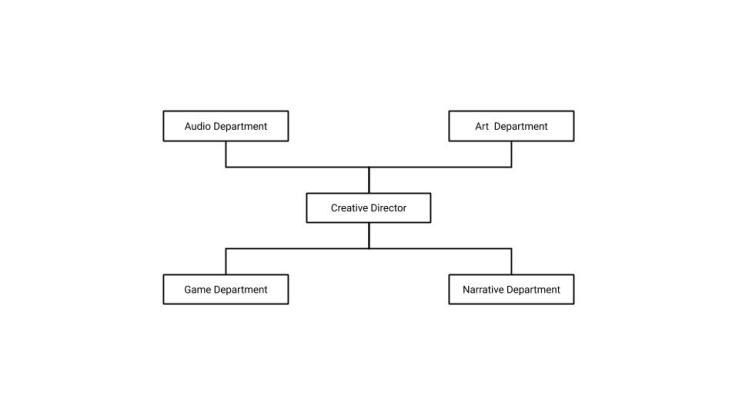
So you see, each department operates relatively individually on separate parts of this game, contributing different elements, and it leads to an end product with a finished game that has had the seams smoothed over with polish and thorough play-testing (ideally). This is not even considering the numerous sub-departments in each section, and many others that have to do with other development cycles, such as the marketing and post-production, as well as future project development. But here lies the issue, by the very nature that game development requires a very different skill set than that of narrative development, the two cycles never meet until completed. Yes, the director and lead designers are there to mitigate this by guiding the respective teams on the desired path, but it can lead to issues nonetheless.
The most famous example of a game contradicting itself comes from the popular origins of the (in)famous term ludonarrative dissonance, with Clint Hocking’s “Ludonarrative Dissonance in Bioshock”. Here, Hocking notices how in the original Bioshock there was a heavy disconnect between the narrative the story was pushing, and the actions the gameplay allowed. In essence, the gameplay encourages (and almost forces) an Objectivist approach to to the world, where you serve your own self-interest, but the narrative was wanting a “freedom of choice”, where you could either accept or reject the notion. As Hocking himself notes, ‘‘helping someone else’ is presented as the right thing to do by the story, yet the opposite proposition appears to be true under the mechanics.’ So we have a disconnect, a dissonance, where the story pushes some concept, and the gameplay undermines it. Conversely, consonance is the opposite, where both story and mechanics operate towards the same goal perfectly (something Shammy’s ludotography aims to achieve in a limited capacity).
What can be taken away from this example are two things. The first is that the game struggles to grapple the concepts it’s trying to explore with all elements, and there is certainly a larger critique to draw from this one. The second, and more honest point, is that the game was ultimately servicing the gameplay experience, rather than the narrative, and that comes from both the departmental split, and the previously mentioned contextual origins of video game narratives. The game went against the story because the gameplay demanded it. It’s not from a lack of care, or a consideration of consistency, but rather because gameplay comes before story, and that is honestly the crux of this whole segment.
Narrative and gameplay are split for numerous reasons, stemming from the origins of the medium to the structural foundations of the companies, but the reality is the baseline of what makes a game good is gameplay. We play games, not stories, and that is the reductive reality of the western industry, and what creative directors and executives alike, and it’s logical. Most games that have you play a story are either a. letting the player enjoy a variation of a “choose your own adventure” story, selecting from a pre-arranged variety of options (e.g. Detroit Become Human, most Telltale games, the Mass Effect series, etc.); or b. creatively inter-link the ludo and the narrative via experimental designs.
I go way more in-depth on this latter half in my dissertations, but to surmise, games like Return of the Obra Dinn, Papers Please, and Hellblade: Senua’s Sacrifice convey the narrative via the mechanics themselves (in a ludotographic way, if you will) by having them be integral to the narrative’s conveyance. If you weren’t an insurance detective with a magical compass, digging through memories and moments of people who passed on, you would have nothing to explore on the Obra Dinn; if you were not a ticket officer in an oppressive regime-ridden country, letting people pass or be rejected would have no moral weight; if you weren’t a woman suffering from schizophrenia going on a self-exploratory adventure, there would be no puzzles or combat. And these are unique games in that two of them were wholly designed by Lucas Pope, who is responsible for the entire game, from start to finish. Much can also be said for games like Undertale, which was also made by one person. These games don’t have the company structures limiting their designs, or leading to creative compromises in pursuit of commercial success, as they are essentially limitless in creative freedom. They are limited in resources, and development, absolutely, but much like an author co-writing a novel, the vision becomes clearer with less voices wanting to be heard. The same cannot be said for Hellblade, as I would consider that an achievement, and an anomaly in many ways (although I hope this not to be the case).
What should be clarified is this ludo-narrative distinction is not a problem, nor something to be solved, but the design of the games. These games service different desires, and the designs achieve different results. If you want a cinematic experience, have a cinematic game like Uncharted; if you want a pure gameplay experience with little-to-no story, look to Tetris; if you want the two to service one-another, do that, and find inspiration for it. The problem here is that people aren’t really exploring that third pillar, so to speak, making it difficult to imagine. There are a handful of examples, and many theoretical ways to achieve this pillar, but it’s difficult, and that’s what I’m excited by. Games are a very new medium in the grand scheme of media, and much is still to be explored. I’m excited by the coming decade, now that the growing pains are subsiding. Maybe the transition to maturity will do something to the medium; maybe the 2020’s will show themselves to be the renewed golden age of video games. We’ll collectively forget 2020 though, that’s for sure.

 Ian D. W.